Three examples of important content for understanding the true nature of the Israel/Hamas conflict

Following the disgusting and senseless actions of Hamas we are now in yet another time of war involving Israel.

But it’s not merely the reports on the atrocities that instigated this latest crisis that we need to discuss. It’s also the actual reporting of it. Just a couple of weeks ago my wife told me she wanted to watch the movie 1984 with John Hurt and Richard Burton. And while the term “Orwellian” might be overused these days, it certainly has to be said that large portions of the mainstream media have reverted to 1984-style propaganda from the moment news of the (again, reprehensible just in case it isn’t clear how I feel) Hamas action broke.

I could go on about my feelings on this matter but the purpose of this post is to share some media which has been produced by people who understand the situation much more than I do yet find themselves able to approach it with a holistic view rather than a “we stand squarely behind Israel no matter what, and anyone who doesn’t totally agree with us is an anti-Semite” one.

So here they are, I hope you either have the time to watch/listen or at least have been able to find similar open-minded discussions and presentations out there.

Apologies for not posting for so long, I could literally produce multiple posts every single day but most of my online time has to be taken up with rugby, especially now. I’m hoping to start a TikTok account for this site soon. JLP

1. POD SAVE THE WORLD

First we have a podcast from Pod Save The World, an excellent production featuring Tommy Veitor (of parent show Pod Save America) and Ben Rhodes (who worked with the US State Department under President Obama) which generally talks about world news from a US perspective, which some may see as a contradiction as the vast majority of the population is definitely ignorant of anything to do with global politics. They normally have a show during the week but they got together for this special one immediately after the news broke, and this is why I appreciate their extremely balanced view which pointed out the actions of the Netanyahu government as well.


2. THE YOUNG TURKS

Next up we have The Young Turks, generally hosted by Cenk Uygur and Anna Kasparian, but for their first show after the Hamas attack, Anna gave up her seat to occasional guest Ben Gleib, and Israeli-American comedian who is always promoting Progressive values, a fact proven by his very existence as a TYT host. But with a lot of his family members living in Israel and some directly affected by the Hamas attack, he is of course extremely well placed to offer that perspective.

So for this protracted debate, which I would recommend you watch in its entirety, we not only have the standard “anti-Occupation” viewpoint offered by Cenk, but it also comes with strong rebuttals from someone speaking for Israeli citizens in the aftermath of a horrific atrocity.

Unfortunately the video is age-restricted so I can’t share it directly to the page, so instead I will add the link below.

CLICK HERE TO WATCH THE YOUNG TURKS DEBATE ON YOU TUBE


3. THE DAILY SHOW

Even with the terrible nature of a story like this, it is actually possible to turn to comedy for both solace and, most crucially, information.

This clip may not be a current one from The Daily Show (it first aired in 2014), but it is still perfect for illustrating just how polarized the media landscape becomes whenever Palestine is in the news.
Pushback on buybacks… ๐Ÿ™„

Over on my rugby site I recently saw a link on Twitter to an article I wanted to read and to read it I had to get a free subscription to the publication so I signed up with a view to cancelling once the money was about to kick in.

Well, that time is approaching so I thought I’d share this “article” with you because I thought the headline was hilarious.

“BUYBACKS AREN’T BAD”???????????

One of the reasons they ARE bad is that corportions used govt handouts after COVID to buy back their own shares rather than to help their customers by lowering prices. This article tells us it’s a good thing because it helps provide a good dividend for investors. Well DUH!!!! That’s like a bank robber saying the theft was good because it helped him buy a Rolls Royce!!!!

The argument laid out in this argument is essentially “trickle down economics” which is all I need to know that I should NEVER pay for subscription, Shame, because they do have quite a few rugby articles, although if anything that fact helps underline the contradiction of a Progressive following rugby union! Might as well move into golf and Polo as well while I’m at it!!!

I have copied a bit of the article just to show I’m willing to let the author make his own argument, while respecting the firewall by not publishing the whole lot.

When companies buy back their shares, as AIB did two weeks ago, itโ€™s common for them get stick for it. Youโ€™d expect criticism of the practice fromย The Guardian, but even theย Harvard Business Reviewย is pilingย on.

Their argument goes like this: itโ€™s bad when companies buy their own shares back because itโ€™s money that could have been used for wages or investment. The argument is that buybacks reduce wages and investment, so theyโ€™re bad for society.

But buybacks are good for investors. And more importantly, theyโ€™re good for society.

A company is doing a good job when itโ€™s maximising its value. Obviously thatโ€™s true from the perspective of the companyโ€™s shareholders. But itโ€™s true for society too. 

When a company is maximising its value, itโ€™s combining a bunch of inputs like land, labour and machinery in such a way that the whole is more useful than the sum of its parts. Society gets more value from a bakery than it does from flour, workers, vans, ovens and land. The extra value created for society is reflected in the value of the combined entity, relative to the value of the separate inputs. 

Sean Keyes on investing: Buybacks arenโ€™t bad bad

Podcast : US media “forgets” that governing is for everyone

Democratic candidate for governor of Georgia says one thing, US media spins it as another – and not just the right wing media either.

An article on what Stacey Abrams actually said > Georgia GOP attacks Stacey Abrams … for speaking the truth (msnbc.com)

How Fox News covered the same speech > Stacey Abrams calls Georgia ‘worst state in the country to live’ | Fox News Video

The True Centre Podcast 011 – "The Cost Of Living Coalition March" The True Centre Podcast

My thoughts on the Irish Left in general and a march/rally in Dublin on Saturday in particular. Learn more about the Cost of Living Coalition here > https://www.facebook.com/COLCIreland
  1. The True Centre Podcast 011 – "The Cost Of Living Coalition March"
  2. The True Centre Podcast 010 – "Beware The Thirty Odd Percent"
  3. The True Centre Podcast 009 – US media "forgets" that governing is for everyone
  4. The True Centre Podcast 008 – Elon Musk helps me define 'true centre'
  5. The True Centre Podcast 007 – Happy 20th birthday TYT

Elon Musk graphic proves “left/right” depiction of politics is arbitrary

“Elon Musk is buying Twitter, blah, blah, yaddya yaddya.” I lead with this paragraph in case you think this article has anything to do with that.

For now I’m much more interested in this graphic that he posted on his soon-to-be playtoy

I don’t care what point he’s trying to make here, especially given he named one of his children “X ร† A-12” and chose to put a car into orbit. For me, this actually highlights two points he may not have intended.

  1. He clearly believes, like most uber rich probably do, that the world revolves around him. The entire human race is represented by three stick figures on each line and he is one of them.
  2. More importantly for this web page, these varying depictions of the “left/right” nature of political thought are completely different each time, which to me proves that it is completely arbitrary. If Elon is proclaiming that they have these definitions for these particular years, why can’t we attribute our own?

Which leads me conveniently back to the most important point I want to get across in this blog, and you will see me repeat it in several posts. If you come across FPP and don’t leave it at least knowing that I firmly believe this, then I will have failed.

In my humble opinion, no matter what year it is, the true centre of a line representing political ideology is one that contains people who want a democratically elected government to provide equal opportunities for all of its citizens. As you go to the right, you have people who are supporting increasing amounts of inequality. As you move to the left, you have people who are more interested in fighting/punishing those on the right than actually working to establish/maintain that equality. Any other depiction of what is defined by “left” and “right” is an attempt to distort, usually from the “right” because they represent a minority of people but currently have a lot of power which they use to influence the masses.

THIS is what I’d like to talk about when it comes to Elon Musk, not whether or not he wants to add an edit button,. JLP

The True Centre Podcast 011 – "The Cost Of Living Coalition March" The True Centre Podcast

My thoughts on the Irish Left in general and a march/rally in Dublin on Saturday in particular. Learn more about the Cost of Living Coalition here > https://www.facebook.com/COLCIreland
  1. The True Centre Podcast 011 – "The Cost Of Living Coalition March"
  2. The True Centre Podcast 010 – "Beware The Thirty Odd Percent"
  3. The True Centre Podcast 009 – US media "forgets" that governing is for everyone
  4. The True Centre Podcast 008 – Elon Musk helps me define 'true centre'
  5. The True Centre Podcast 007 – Happy 20th birthday TYT

PS : It seems The Young Turks agree in this video and of course they put their own spin on it which is worth a listen. But sure what do we know, we’re just “woke progressives” right????

“Ballymun regeneration” : what really happened as explained by resident in tweet thread & video

I have long been interested to know what actually happened in Ballymun – not enough to do extensive research mind you, and one notable sidebar from this thread is that if the were to meet me, his first impression might be to see me as some kind of “Rugby Dad/Newstalk Niall” hybrid, but still I was grateful to him for tweeting this extensive info so I thought I’d share it here. Check out the link at the end to watch the video if the embed isn’t working.

Everything below this line of the post was written or produced by the author in question. JLP

Since Ballymun comes up a lot in discussions of the housing crisis, here’s a thread debunking some of the most persistent myths/misconceptions/lies about the community.

(I made a film about this some years ago, but people were largely indifferent, so this is a capsule summary).

Rugby dads, professional gentrifiers and Newstalk Nialls generally reference Ballymun as a “knee-jerk response” to a housing crisis (mostly false), a utopian project (totally false) and a failed housing model (also false).

The truth is, Ballymun was the Irish state doing what it does “best” – the bare minimum of public provision it can get away with. There was no failure of utopian planning because there was no utopian planning. Promises of cinemas, bowling alleys and amenities were always false.

That said, the blocks themselves were built to a French system and were generally sound, bright and spacious.

Ours had a large living room with private balcony, a large bedroom, two smaller bedrooms, a bathroom with bath and constant hot water, and a decent-sized kitchen.

But it swiftly became apparent that Dublin Corporation (now Dublin City Council) – whose senior officials always resented the fact that the National Building Agency had been entrusted with the lucrative project – had no intention of providing even basic services or maintenance.

In the early years, the community itself plugged this gap. Communal areas were scrupulously maintained by residents. To the best of its ability, an impoverished community stood in for the absent state. It built structures of mutual support and recreation that endured for decades.

Eventually, however, successive economic crises overwhelmed residents. From the 80s onwards, several waves of heroin addiction swept over the area, on the heels of a prescriptions drugs epidemic.

A beleaguered community lost the ability to do the Corpo’s job for it.

While the plethora of community organisations rallied and survived, the area deteriorated physically and economically.

Ballymunners made numerous earnest attempts to engage the state over the heads of the Corpo, which had by now largely abandoned the area to its fate.

These heroic efforts kept the community above water, until, in the late 90s, government finally yielded to pressure and announced a Regeneration project (an earlier attempt in the early 90s having been abandoned at about 10% completion).

This was to be enacted by a new limited company wholly owned by Dublin Corporation – Ballymun Regeneration Limited (BRL).

Inspired by Blairite thinking/models from the UK (and shipping over some of the same personnel), BRL swiftly decided on total demolition of the high rises

It should be explained here that outright gentrification (displacement and replacement of the community by more affluent residents) was off the table for a variety of reasons; chiefly, the fact that the community itself had forced the state’s hand and had to be won over.

While BRL carried out an elaborate pantomime of consultation (within already-defined parameters), its mission became clear:

Since the area couldn’t be gentrified, an attempt would be made to gentrify its people instead.

This would entail the forcible destruction, not just of the physical infrastructure of the community (tower blocks, green spaces, centralised shopping areas, community centres etc), but of all communal experiences of life in Ballymun.

BRL was quite explicit about this. The purpose of the Regeneration was to liquidate the existing community of Ballymun, with its communal forms of solidarity, and to allow residents to be reborn as responsible, market-oriented individual consumers.

The hodge-podge of architectural styles (sidenote: between 1997 and 2014, BRL spent โ‚ฌ98.7m on professional fees alone) were all designed to achieve this.

Gone were the sweeping open spaces and the central meeting places that had fostered a community.

In their place – isolated developments that encouraged, and enforced, suspicion and exclusion of all but one’s immediate neighbours.

Ballymun’s vast network of community organisations – from football clubs to legal aid to tenants’ associations – was systematically dismantled.

These relics of non-market community identity (as BRL saw them) were brought under the banner of a BRL-run Neighbourhood Council, which was run into the ground and dissolved within a couple of years.

A tangent before the conclusion – it is shameful that anyone still parrots BRL’s mantra of “mixed income housing”.

The thinking here (explicitly stated in Ballymun) is that well-adjusted middle-class residents act as role models for their feckless working-class neighbours – vile

The Regeneration was, by every metric except BRL’s own, an abject failure. Estimates of its cost vary from โ‚ฌ1bn-โ‚ฌ2bn.

Ballymun was destroyed – socially, economically and culturally. The private sector investment on which BRL had based its Blairite fantasies never materialised.

The moral of the story:

When you see planners, politicians and pundits warn of “creating new Ballymuns”, always remember that they, and people who think like them, were given 20 years and a blank cheque to “fix” Ballymun according to their own ideology.

They utterly failed.

What really stuck in their craw about Ballymun was not the widespread, visible poverty (after all, these people have created a city strewn with the tents of the homeless), but the forms of solidarity and resistance to market ideology which Ballymunners carved out for themselves.

So yeah, if a politician, planner or developer arrives in your town with a “regeneration masterplan”, run them out of there before it’s too late.

Leo should remain as Taoiseach for now but not without strong Opposition and challenging media #COVID19Ireland

These are unprecedented times.  Our worlds have been turned upside down and we have absolutely no idea what comes next.

I have been periodically blogging on this site for almost four years, and I have never made a secret of the fact that I believe in a Progressive government for Ireland.  This of course means the parties which have always represented the status quo such as Fine Gael and Fianna Fรกil have never gotten my vote. I also have little faith in other parties purporting to be โ€œleftโ€ such as Sinn Fรฉin and Labour.

Yet when faced with a situation like COVID-19, I do not believe that a radical change to the face of our government is what is needed, even when it comes as it did right after a general election.  Leo Varadkar and Fine Gael were in power when it was time to lock the country down and particularly in the most relevant departments like those of An Taoiseach and Health, we need continuity and stability so regardless of political hue I think the correct course would be for them to remain for now.

Now Iโ€™m hoping that my established premise will be remembered as I voice some concerns over the current situation.  In his address to the nation on St Patrickโ€™s Day, Leo Varadkar literally referenced Winston Churchill.

โ€œThis is the calm before the storm โ€“ before the surge.  And when it comes โ€“ and it will come โ€“ never will so many ask so much of so few.โ€

Address by An Taoiseach, Leo Varadkar 17th March

For the life of me I cannot fathom why there was not more of a backlash to this.  I am absolutely no fan of Sinn Fรฉin but am I the only one who sees the irony in the fact that they would be lambasted for any kind of Nationalist references at this time yet our Taoiseach, one who has often expressed a liking for the leadership of one conservative UK leader in Thatcher, gets a free pass after throwing a nod to another?

This point is one of semantics and cosmetics I know, but I make it first because of the levels of reaction I have seen on social media ever since.  Of course we need to stick together as much as possible during these times, and given the original nature of the crisis there should be much leeway afforded to our government, yet the levels of praise for his leadership have been, in many, many cases, โ€œChurchillianโ€, and this concerns, nay frightens me.  

Strong opposition and challenging media are important ingredients to any democracy.  If a day ever came when Ireland had Progressives seated around the Cabinet table, I would expect nothing less than for them to have their feet held to the fire where possible, and we all know that would be the case.

And while the Green Party did not get my vote at the last election either, I cannot understand why they are being vilified for not unconditionally joining FF and FG in government.  They claim to have offered three options to the โ€œCivil Warโ€ parties, all of which have been rejected…

“I think the idea that FG and FF would present this narrow option to the people of the two of them in power with one of the smaller parties propping them up is very self-serving. It has the coincidental effect of giving them the most amount of power, for the most amount of time with the least amount of oversight.” 

Green TD Neasa Hourigan

Why are politicians so reluctant to form a government?
Justin McCarthy – RTร‰.ie

…and the backlash appears to be โ€œshut up and get on boardโ€. Whatever your levels of respect were for them before, surely they would be lowered should they accept those terms.  But this post is not just about the Green Party. Itโ€™s for the type of representative body we want the Dรกil to be when it comes to acting as a check on our Government.

Then there is the Irish mainstream media, one that already had a reputation for being more stenographers than challengers.  And that was even before this particular Taoiseach came to power, one who sought in virtually his first act to set up a media arm with the sinister title of the “Strategic Communications Unit“.

Below are just some areas where I would like to ask questions of Leo Varadkar and his government, in no particular order:

  1. What exactly happened with those orders from China which arrived with inadequate supplies?
  2. If Opposition parties should feel shame for insisting that the Dรกil convenes due to risk of social distancing among civil servants, have any measures been discussed to allow for some kind of COVID-19 friendly Dรกil sittings until the crisis is over?
  3. COVID-19 tests – they are in limited supply.  Is there any transparency as to how they are allocated?  And I have heard stories that the testing itself can take over two weeks to produce results – why is that, is anything being done to speed up the process and is this fact reflected in the numbers we are being given?
  4. We have all has been adversely affected by this crisis, but that does not mean we will all be struggling by its end.  When everyoneโ€™s assets have been reduced, the priority of Government care should be those who are left with little or nothing.  So what exactly do you mean by โ€œtough decisionsโ€ that have to be made once this crisis is over? Is there to be a period of austerity similar to that affected by the banking crisis or will the burden at very least shared regardless of wealth if not borne by the 1% at the top?  

I am happy for Leo and Simon to remain in their jobs.  I am delighted that Leo is rolling up his sleeves to pitch in as a GP.  Thatโ€™s all great. But if a republic values its democratic principles, no government should go unchecked, and we certainly shouldnโ€™t assume everything is rosy on these shores based on a comparison to the leadership of the blond buffoons either side of us.  All Iโ€™m asking is that we be mindful of this. JLP

#IrishMediaWatch #GE20 : RTE 9oc News Wed 15.01.20

Mr Varadkar said he was very concerned about the case of a man who was seriously injured after the tent he was sleeping in was removed from the banks of the Grand Canal by an industrial vehicle. 

Housing issue dominates first day of election campaign
Paul Cunningham RTร‰.ie

Now that #GE20 is underway I’m planning to keep an eye on the national media outlets to see how they are covering the campaign trail, just to see how balanced the coverage is. For this first installment I have to say things were better than I expected.

On RTร‰’s Nine O’clock news Wednesday, the election featured third in their running order although the piece was related to the second story, about a homeless man who was badly injured by an industrial vehicle which was cleaning a canal area and apparently didn’t know the man was still in his makeshift tent.

This provided a seguรฉ into their election coverage as Leo Varadkar was questioned about it on the campaign trail, and in his remarks he suggested a statement from the Lord Mayor of Dublin was appropriate. In response, Micheรกl Martin accused the Taoiseach of politicising the tragedy since the Mayor is currently from Fianna Fรกil.

After watching the quotes from the two men I thought “this is typical – on a classic progressive issue here’s the two Civil War parties finding a way to argue over anything BUT the search for real solutions.”. But to be a little fair to our national broadcaster, for this topic they did at least broaden the scope of opinion.

We also heard from Labour leader Brendan Howlin, who outlined his party’s plans to allocate actual money to address the problem of homelessness by way of improved social housing. The problem with that, of course, is that it’s all very well saying what you;d do if your party held a majority in the Dรกil, but the odds of that are slim and none.

Eamonn Ryan of the Greens also chimed in, saying that this was a serious issue that needs to be addressed. Finally Mary Lou McDonald of Sinn Fรฉin appeared more interested in having a pop at RTร‰ (re exclusion from debates, something I’d agree with her on if that were the topic) rather than comment on the situation at hand, although it is very possible that the clip was selectively edited.

So no progressive opinion in this piece, although Independent Councillor Anthony Flynn was interviewed for his opinion on the unfortunate homeless man.

VERDICT

As far as I’m concerned, any kind of election coverage that looks for opinion beyond the “Big Two” parties is an achievement by the Irish corporate media. I’ll give them 6 out of 10 for this piece – I wonder will anyone score higher between now and February 8? JLP

“Housing crisis? What housing crisis?” asks Irish mainstream

“We continue to expand our macroprudential framework to ensure we have the right tools to manage potential risks to financial stability and the addition of the Systemic Risk Buffer will be an important tool for us in building a resilient banking system with sufficient capital buffers to absorb these structural shocks.”

[translation : “We want you to forget this mess is partly our fault by pointing to Brexit and using intentionally complicated economic jargon”]

Article in Journal.ie by Cormac Fitzgerald : “Hard Brexit could cause house prices to fall, Central Bank warns

Brid Smith TD addresses Drimnagh residents on the proposed ‘carbon tax’

FB_IMG_1554994623291

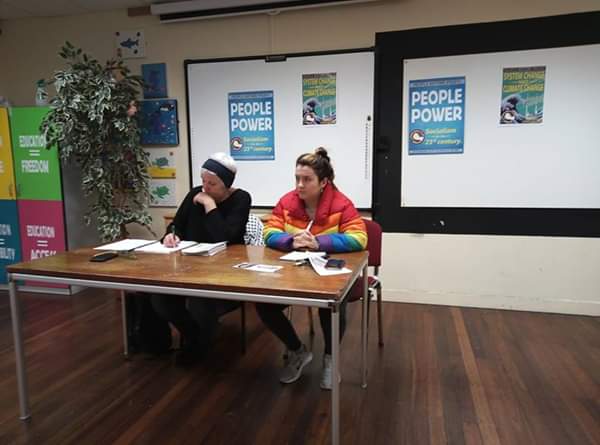
I could have been at home watching Manchester United v Barcelona.ย  But I made myself a promise that I would make an effort to get more involved in local politics, and given the amount of signs I have seen around the area for this meeting in St John Bosco Youth Club, a mere ten minute walk from my front door, to not go would be to break that pledge.

The meeting was held by local councillor Hazel De Nortรบin.ย  Now when I say ‘local’, she hails from Ballyfermot, yet she represents me as Drimnagh has been curiously cut in two and my house falls in the ‘Ballyfermot/Drimnagh’ zone.ย  Still, the very holding of this meeting shows that the councillor is willing to be involved throughout the ward.

Her party is People Before Profit.ย  I confess to knowing little about them, save for assorted Facebook posts, but I do know that their name itself is closely aligned to my politics so it was a safe bet that I would feel at home in this company.

The principal speaker was Brid Smith TD and the theme was ‘Why Carbon Tax Won’t Stop Climate Change’.ย  She began by highlighting the protest by schoolchildren all over the country, but particularly outside the Dรกil. where over 15,000 were reported.

Deputy Smith also pointed to a poll which found that 39% of Irish people saw climate change as one of the most important issues of today, adding that while some might think that was a low percentage, she was actually encouraged by it.

She has recently been sitting on a Special Oirechteas Action Committee which followed on from a Citizens Assembly.ย  She referred to it as more of an ‘Inaction’ committee because it appeared that the decision to level the carbon tax on ordinary citizens was already made.

She claimed that the supposed thinking behind the tax was that if people’s habits could be changed, ie if we can move away from carbon-intensive forms of energy, then supposedly this would influence (‘by osmosis’ as she ironically called it) the large corporations.

An interesting plan if true…especially given that when it comes to distributing wealth, corporations tend to favour things going in the opposite direction.ย  When it comes to the carbon tax, should we call their plan “Trickle up?”

She also pointed out that even if carbon taxes did have some positive effect, they would never be enough to tackle climate change on their own, yet once implemented the government could well consider them to be a ‘catch all’ of sorts.ย  ‘The one tool becomes the only tool’.

Next the TD covered the whole area of ‘Just Transition’ – when she explained it I knew what she meant though I had never heard it called that before.ย  Basically when a society moves from one form of energy to another, care must be taken that the existing workers in the old service are offered the opportunity to move into the new field.ย  Seemingly People Before Profit have been working with Bord Na Mona workers in this area.

Apparently three of the main political parties, Fine Gael, Fianna Fail and Labour, along with the Green Party, are in favour of pushing ahead with this tax, which probably means it is likely to go through.

In the interest of fairness I took some time to go over the websites of various parties to see how they presented their policy (if any) on carbon tax and/or climate change in general…

FINE GAEL – banner on homepage #TogetherOnClimate Climate Action – when you click it you see 16 links under heading of โ€˜progressโ€™ none of which refer to carbon tax.

โ€˜carbon taxโ€™ search produced links on Special Oireachtas Committee

FIANNA FAIL – No search facility. No mention of carbon tax under section โ€˜tackling climate changeโ€™

LABOUR – โ€˜Labour’s clear preference is for ring-fencing funds from carbon taxes to pay for home retrofitting, including in local authority housing, and other ways of reducing energy povertyโ€™

SINN FEIN – โ€˜Imelda Munster has criticised the agreementโ€ฆto increase carbon tax four foldโ€™

GREEN – Cuffe : โ€˜The aim of the carbon dividend, or carbon cheque, is to change behaviour. By placing carbon taxes and giving back what is taken to households it provides direct incentives for people to move to low carbon heating.โ€™

SOCIAL DEMOCRATS – can’t find policy on carbon tax but policy section shows they are keen to reduce emissions
RIGHT2CHANGE 10-Point policy programme – โ€˜A Progressive Government will make protection of the rights of Mother Earth a Constitutional Imperativeโ€™

โ€˜The IFA is up in arms over suggestions that people should eat less meat and drink less milk. No doubt carbon taxes will be pushed also as a key part of this debate.โ€™

โ€˜Women make up 70% of farmers world-wide yet only own 2% of land…they are responsible for 90% of the caloric intake of the average familyโ€™

SOLIDARITY – nothing on climate change on โ€˜what we stand forโ€™ page

…just to be clear, my research for the above information was not exactly extensive.ย  There are so many parties in the jurisdiction that it isn’t easy to keep up with them all.

As you can see my attention was drawn most to the Right2Change platform – the quotes above were taken from the Facebook page of Joan Collins TD.ย  I like the way they constantly use phrases like “Under a Progressive Government Ireland can…” because while that may be extremely aspirational right now, if we don’t discuss and use such terminology regularly, it could remain so.

But that’s not to say I was completely turned off the PBP folks just yet.ย  They passed around a page for names and addresses – I offered my information though I fell short of ticking the ‘Join’ box for now.

When the meeting was over a chatted for a few minutes and then left.ย  I was first to head for the door and Deputy Smith thanked me for attending.

I’m glad I did, and I look forward to following the progress of the PBP’s resistance to the introduction of the tax.

Next on this site I’d like to start covering the various candidates standing for election to the council in May.

#IANWAE